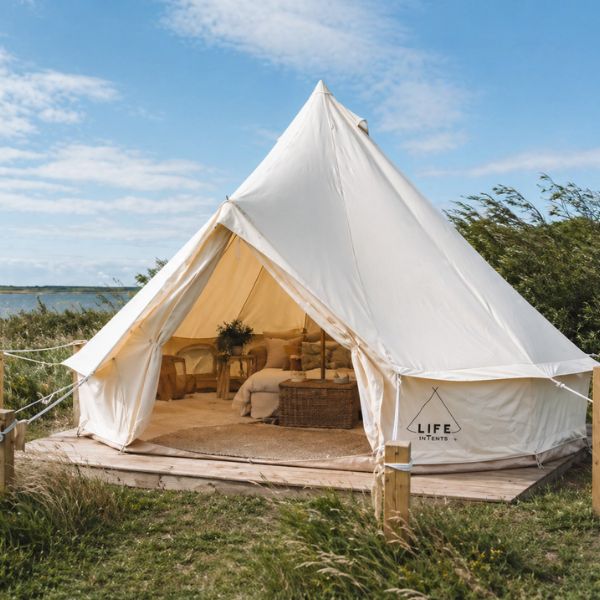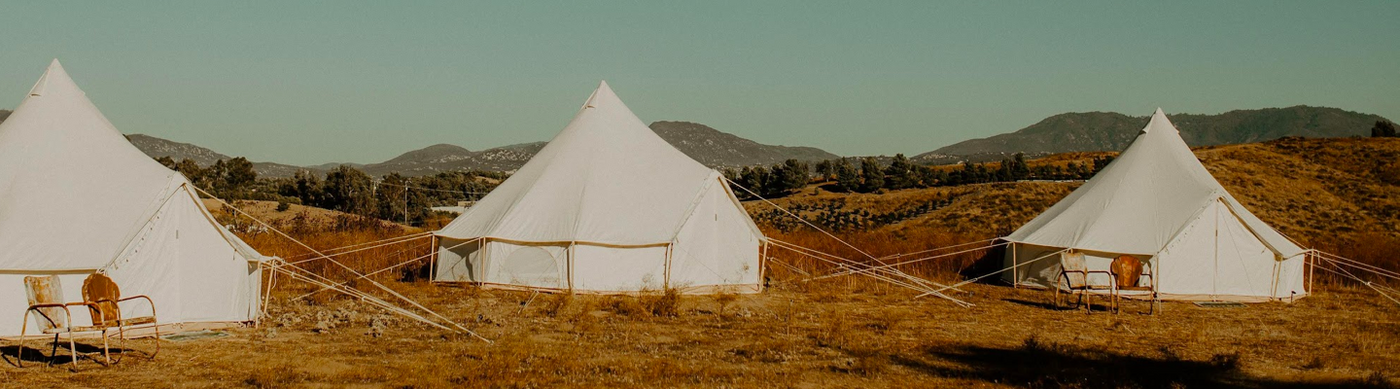
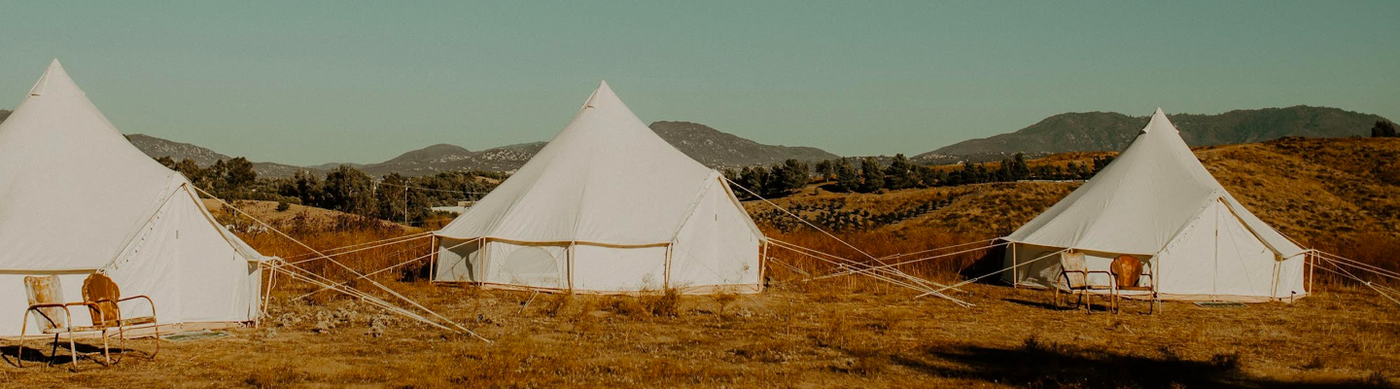
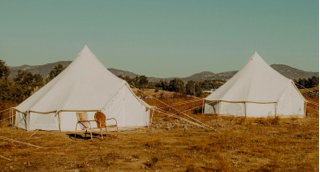
A waterproof canvas bell tent can be set-up for a couple of consecutive weeks without requiring much maintenance. But if you plan on keeping your bell tent up for several weeks/months then you will want to take precautions to make sure that it is well protected from standing and running water. One of the best ways to accomplish this is to build a bell tent platform.
A good tent platform is essentially a level, well-drained wooden deck sized so the entire tent floor sits securely on the platform while still leaving enough room for proper guy-line placement. For a long-term bell tent setup, the platform should be built with outdoor-rated materials, securely supported, and designed around the exact footprint and guy-line geometry of your tent.
The biggest mistake is designing only for the tent floor.A bell tent also needs space outside the walls for its guy lines to extend at the proper angle.

Key Takeaways
A wooden platform is the #1 way to protect a bell tent left up for weeks or months: it lets water drain away, reduces guy line re-tightening, and helps the tent last longer. For a 16-foot (5M) bell tent, common decks are 20' x 20' or 20' x 30'. Use treated lumber and weather-rated fasteners, or a decomposed granite rock bed as a cheaper alternative.
Jump to
Related: How to Start a Glamping Business · Living in a Canvas Tent · How to Set Up a Bell Tent · Shop bell tents
PROS & CONS OF A TENT DECK:
|
PROS |
CONS |
|
Your tent will last much longer (if pitched properly) |
Obviously more expensive. |
|
Allows water to escape, rather than puddle under tent. |
The deck itself will need to be maintained. |
|
Guy lines won't need to be re-tightened as much. |
Tent requires precision to set-up properly (especially at stress anchor points). |
|
Prevents mud dirtying side walls when it rains. |
Tent will experience less "give" during extreme weather. |
|
Discourages insects and animals from living under your tent. |
A bit more time consuming to put up and take down tent. |
|
Reduces tracking debris into tent. |
May require a permit. |
|
Oh, and they look great! |
|
A tent platform keeps your tent off damp ground, speeding up the drying process of the canvas - discouraging the growth of mildew in locations where the sun has difficulties reaching. The platform also helps to encourage air circulation around the lower walls and the floor to help dry out damp canvas.
This insurance does come at an added cost, but it is well worth the extra time and investment.
SHOP LIFE INTENTS BELL TENTS
Selecting a Tent Platform Design
Platforms can be built in many shapes and sizes, and there isn't one design that works for every site. For a 16-foot (5-meter) bell tent, common platform layouts include a 20' x 20' square, a larger rectangular deck such as 20' x 30', or a multi-sided platform that follows the shape of the tent. A larger platform can also provide room for chairs, an awning, or an entry porch.
When sizing the platform, remember that the tent's guy lines extend beyond the floor footprint(fly cover lines extend even further / higher).. Plan for those anchor points before finalizing your deck dimensions.

The design decision for you will be determined based upon your desired function, form, and finances. The three main drivers behind the cost of a platform are: materials, labor and design.
-
The larger the platform, the higher the material cost.
-
Hiring a carpenter requires a higher cost vs. a DIY approach.
-
The more elaborate your design, the more time it will take to build (see bullet #2).
You may also need to add footings to your platform if your site is not level, possibly even requiring the addition of a stairway to get to the front door.

Tent Platform Plans: Creating Your Deck Design
Once you have your design in mind, it's time to sketch out the plans. If designing with CAD isn't one of your many skills, your contractor should be able to help create plans for the project. A good set of plans will help determine how much lumber, hardware, and support material you'll need.
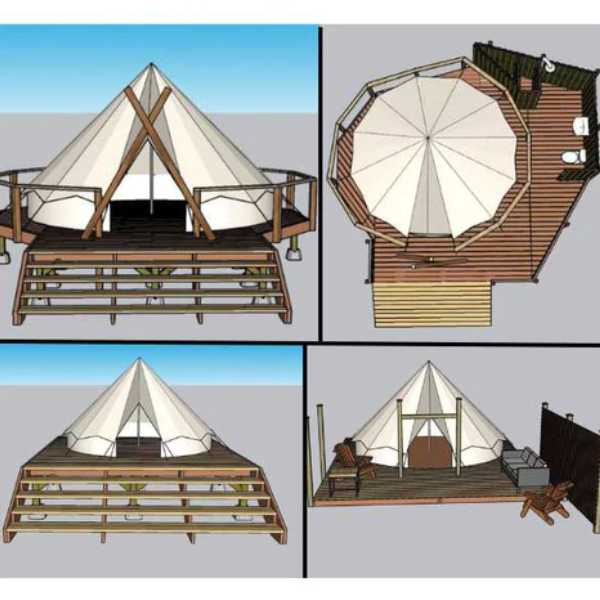
Here at Life inTents, we've developed bell tent deck plans designed around our 5-meter (16-foot) and 6-meter (19-foot) bell tents. They include space for an entry porch, stairs, and structural support.

Tent Deck Material Considerations
Your platform will be exposed to extreme weather conditions that will vary by your location. Sun, rain, snow, and humidity can each erode the condition of your platform over time. It is recommended to use treated lumber and fasteners that are fabricated to withstand changing weather conditions.
Cedar and redwood are two of the better wood choices for bell tent decks, followed by the more economical option of pressure treated wood.

How Much Does a Tent Platform Cost?
The cost of a tent platform can vary considerably depending on its size, height, lumber choice, site conditions, local labor rates, and whether you're building it yourself or hiring a contractor.
A simple low-profile DIY platform may cost substantially less than a large elevated deck with footings, stairs, railings, and a porch. Before building, price the materials locally and determine whether your project will require permits or professional construction. Materials alone might be over $4,000 these days depending on your area
Securing Your Tent to a Wooden Platform
Setting up your tent on the platform generally follows the same process as when putting it up directly on the ground. However, you will want to strategically decide how you will secure the guy lines and the floor of the tent directly to the platform itself.
SECURING THE FLOOR:
Once you place your tent on the platform, your next step will be to securely fasten the floor to the deck at each of the corners – making sure that the floor is tight and free of wrinkles. Instead of using tent ground stakes, you will want to use a bolt or screw to anchor each corner of the tent. To ensure that each corner does not slip over the screw or bolt, we would recommend using a washer to hold down the D-ring of each corner of the groundsheet. Another option is to consider a heavy-duty screw hook.
Note that once the tent is up, you may need to reposition some of the floor fasteners after the poles and guy lines are secured to relieve any excessive or inadequate tension on the groundsheet.
SECURING THE GUY LINE ROPES:

Approximate suggested deck pole location for guy lines
Having a plan to properly secure your guy lines is very important to help maintain the integrity and functionality of your bell tent. We have seen people simply extend their guy lines from the tent and secure them directly into the ground just off of the platform. We caution against taking this approach.
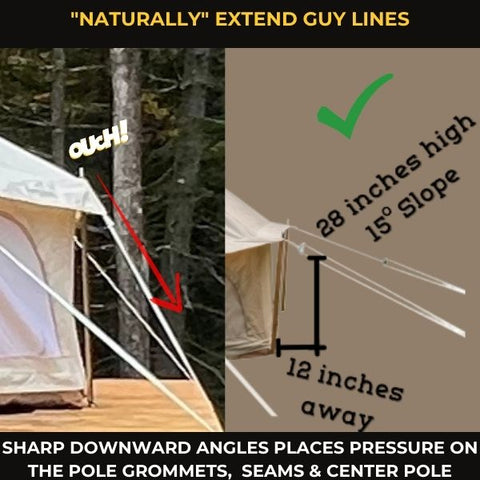
Bell tent guy lines are designed to be extended at a very specific angle off of the roof seams when they are set-up on solid ground. The added elevation created with a platform can create unnatural extension of the guy lines, which then may create incorrect pressure on the seams and poles, which could result in tent seams of your tent ripping in wind storms.

We suggest tying off the guy lines to posts added to the deck (or just off the deck). These posts can be 1-2 feet from the wall of the tent, standing about 2-3 feet tall. This will allow you to extend the guy lines at their intended angle, and also eliminates a potential tripping hazard.
If you plan on using a fly over your tent (which we always suggest), then you will want these posts to be a little taller since the fly cover guy lines will be secured a few inches above the tents' rope.
For the guy line rope that is attached to the door, you could install a taller post, or add a second guy line above the door and tie each off to the posts directly to the left and right of the door.
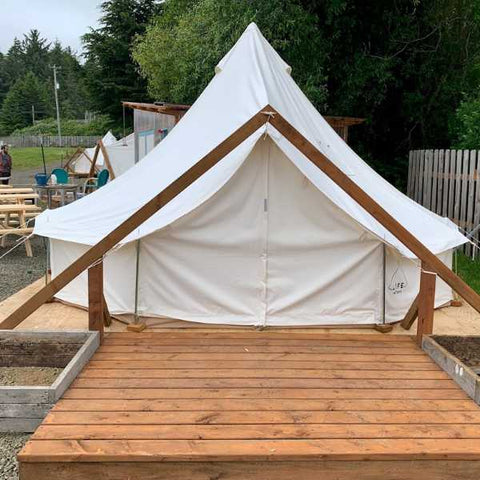
Some great plans are available to download for a reasonable price by our friends at Hazy Woods Design. Below is a small example of some plans that are available for purchase and instant download:
Alternatives to a Glamping Tent Platform
If you can’t afford to physically build-out a tent platform, or would like a quick protective ground barrier, then you could create a flat rock bed to erect your bell tent on top of. We’d suggest using finely ground rock such as decomposed granite or ¼ minus gravel. Frame it in with edging that is about 2 feet off the outside walls of the tent. Then lay down about 1.5”-2” of the material, periodically packing the rock down with every 0.5” layer. This option could be done affordably, with only between $300-$600 worth of material.
Also, adding river rock around the perimeter of your tent will help to prevent water from dripping off your tent and having mud splash up onto the canvas.

What About Portable Tent Platforms?
Portable or modular tent platforms can make sense when a permanent deck isn't practical, particularly for temporary camps or sites where permanent construction isn't allowed. For a large canvas bell tent intended to remain set up for weeks or months, however, a properly built fixed platform generally provides a more stable and durable foundation.
Whichever approach you use, the platform must safely support the tent and occupants and still allow the tent's floor and guy lines to be secured at the correct points.